
 Shift News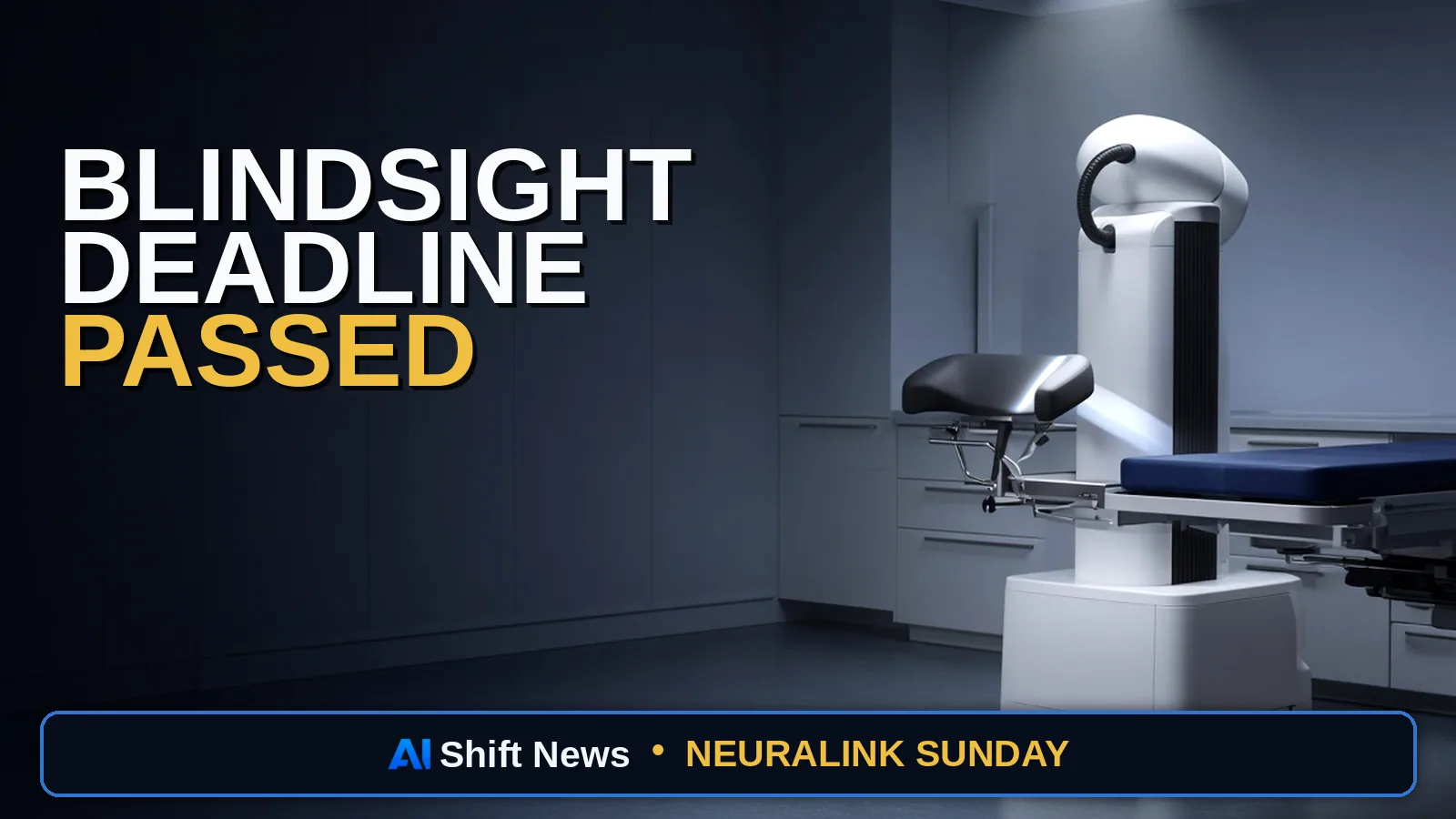
Honest fence (read first): This Neuralink Sunday flagship is a claim check, not an announcement. Neuralink has published no new Blindsight result. Its updates page shows nothing newer than its October 1 pretraining post. The receipts are: Musk’s June 2025 Y Combinator remark, as reported by MobiHealthNews; Neuralink’s Sept 17, 2024 FDA Breakthrough Device Designation for Blindsight; a September 29 viral repost of the old clip; a fake “blind cat” story on look-alike websites; and Andrew Huberman’s October 6 interview on Invest Like the Best (_QSX3BF9UX0). Huberman’s words are opinion from a podcast, not Neuralink data. We quote him from the host’s own clip post because YouTube captions were unavailable to us. What we can say: no public report of a human Blindsight implant, as of October 11. What we can’t say: that nothing has happened privately. Absence of a public report is not proof.
Invest Like the Best — “Why Every AI Lab Will Become a Biotech Company | Andrew Huberman” (published October 6, 2026). Huberman’s point that writing to the brain is harder than reading it is his view, not a Neuralink statement. Neuralink has published no human Blindsight implant.
Editorial Thesis
Neuralink does two different things. It reads the brain, and it wants to write to it.
Reading is where the progress is. Telepathy lets people move a cursor. VOICE lets Kenneth Shock and Terry talk. Those systems listen to neurons and decode intent.
Blindsight is the other half. It has to send signals into the visual cortex so a blind person perceives light. That is a harder problem, and this fortnight showed what happens when a hard problem runs past a public deadline. The gap fills with old clips, recycled hype, and in one case an invented cat.
Honest Verdict
Believe Blindsight is a real program. The FDA gave it Breakthrough Device Designation in September 2024, and Musk has said it works in monkeys. Do not believe it has reached a human. Neuralink has published no such implant. Do not believe the “blind cat Kaya” story. It comes from copycat websites, not from Neuralink. And do not treat the viral September clip as news. It repeats a promise Musk made in June 2025, and the six-to-12-month window it described ended around June 2026.
The fair reading: Blindsight is behind its own public timeline, which is normal for medical devices and worth saying plainly.
What the primaries actually say
The promise (June 2025). Speaking at Y Combinator, Musk said, per MobiHealthNews: “In the next six to 12 months, we’ll be doing our first implants for vision, where, even if somebody is completely blind, we can write directly to the visual cortex, and we’ve had that working in monkeys.” He added that one monkey had carried a visual implant for about three years.
The broader 2026 promise (December 31, 2025). On X, Musk wrote: “Neuralink will start high-volume production of brain-computer interface devices and move to a streamlined, almost entirely automated surgical procedure in 2026.”
The status (October 11, 2026). Neuralink’s updates page lists its October 1 post on pretraining with 50,000 hours of brain data as the newest item. Its last participant count was 21 (January 28, 2026). There is no Blindsight human-implant post.
The viral repost (September 29). An X account posted the clip as if Musk had “just dropped” it, with a paraphrased quote: “In the next 6 to 12 months, we’re going to implant the first vision devices.” It passed 1.15 million impressions. It is the old promise, not a new one.
The fake “blind cat” story
On September 28, a story spread claiming Neuralink had implanted Blindsight in a blind domestic cat named Kaya. It traces to two look-alike websites:
| Fake site | Real site it imitates | What it claimed |
|---|---|---|
| teslarati.org | teslarati.com | “Neuralink Reports First Visual Prosthesis Implant in a Blind Domestic Cat Named Kaya,” with a quote from a made-up “Neuralink spokesperson” |
| neuralinktrials.com | neuralink.com/trials | A copy of Neuralink’s trials page with one added line: “First visual prosthesis implant in a blind domestic cat (Kaya)” |
The X account @seeingwithsound, which tracks vision-restoration technology, flagged it the same morning: “Fake news about Neuralink Blindsight.” A crypto token named after the “blind Neuralink cat” was promoted on X the same day. Neuralink has posted nothing about a cat.
How to spot it: check the domain letter by letter. A real Neuralink update lives on neuralink.com/updates or @neuralink on X. Same rule for Tesla news: the same fake site is running a sensational Cybercab headline this month. We are not repeating it.
Huberman: reading is heroic, writing is the frontier
On October 6, neuroscientist and podcaster Andrew Huberman sat down with Patrick O’Shaughnessy. The episode has chapters on “Implantable Devices” and “Controlling Your Brain.” O’Shaughnessy’s own clip quotes him:
> “Getting people who are in locked-in syndrome to speak, or getting people who have a spinal injury to walk, which Neuralink and others are trying to develop technologies to do. That’s heroic.”
> “I think the coolest problem that’s also the biggest problem is how we can noninvasively write to the nervous system in sleep and waking states… it will probably be ultrasound… That, to me, seems like the most important thing to resolve right now, and it’s totally doable.”
Two things stand out. Huberman praises exactly the reading-side work Neuralink is shipping in trials. And he names writing as the big open problem, but bets on a non-invasive route, ultrasound, rather than an implant. That is a different bet from Blindsight, which uses an implant on the visual cortex. Neither approach has a public human vision result today.
Claim vs proof scoreboard
| Claim | Who says it | Proof level |
|---|---|---|
| Blindsight is an FDA Breakthrough Device | Neuralink (Sept 2024) | Strong — official designation |
| Vision implant works in monkeys | Musk (June 2025) | Company-stated, no paper we could find |
| First human vision implant within 6–12 months | Musk (June 2025) | Missed publicly — no report by Oct 11, 2026 |
| “High-volume production” in 2026 | Musk (Dec 31, 2025) | Unproven — 21 participants is the last official count |
| Blind cat “Kaya” got Blindsight | teslarati.org / neuralinktrials.com | Fake — look-alike sites |
| September clip was new | Viral X post | False — the June 2025 promise, re-posted |
| Writing to the brain is the hard part | Huberman (Oct 6) | Expert opinion |
Who should care
- People who are blind or low-vision, and their families. Blindsight is real research, but there is no human result to sign up for yet. Neuralink’s patient registry is on neuralink.com, not on look-alike sites.
- Anyone sharing Neuralink news. Check the domain before you repost.
- Investors and fans tracking Musk timelines. Reading-side trials are moving. Writing-side vision is behind schedule.
What to watch next
1. A Blindsight post on neuralink.com/updates or @neuralink. That, plus a ClinicalTrials.gov listing, is what a real first human implant would look like.
2. A Blindsight registry entry. PRIME and VOICE have public ClinicalTrials.gov records. Blindsight’s human study would need one too.
3. More fakes. Expect copycat domains and token pumps around any Neuralink news.
4. Non-invasive write work. Huberman’s ultrasound bet is a separate race worth tracking.
Bottom Line
Believe Blindsight is a real program. The FDA gave it Breakthrough Device Designation in September 2024, and Musk has said it works in monkeys. Do not believe it has reached a human. Neuralink has published no such implant. Do not believe the “blind cat Kaya” story. It comes from copycat websites, not from Neuralink. And do not treat the viral September clip as news. It repeats a promise Musk made in June 2025, and the six-to-12-month window it described ended around June 2026. The fair reading: Blindsight is behind its own public timeline, which is normal for medical devices and worth saying plainly.
Sources
- Neuralink Updates — newest post Oct 1, 2026 (50k-hour pretraining); no human Blindsight implant post
- Neuralink — Blindsight receives FDA Breakthrough Device Designation (Sept 17, 2024)
- MobiHealthNews — Musk at Y Combinator: first vision implants 'in the next six to 12 months' (June 23, 2025)
- Elon Musk on X — 'high-volume production … in 2026' (Dec 31, 2025, 6:51 PM ET)
- Viral repost of the vision-implant clip framed as new — ~1.16M impressions (Sep 29, 2026, 8:50 AM ET)
- @seeingwithsound — 'Fake news about Neuralink Blindsight' warning on look-alike domains (Sep 28, 2026)
- Invest Like The Best — Why Every AI Lab Will Become a Biotech Company | Andrew Huberman (Oct 6, 2026)
- Patrick O'Shaughnessy on X — Huberman on Neuralink clip and quote (Oct 6, 2026, 8:13 PM ET)
- AI Shift News — Blindsight is a real visual-prosthesis program, not a verified restored-vision result (Sep 20, 2026; context)