
 Shift News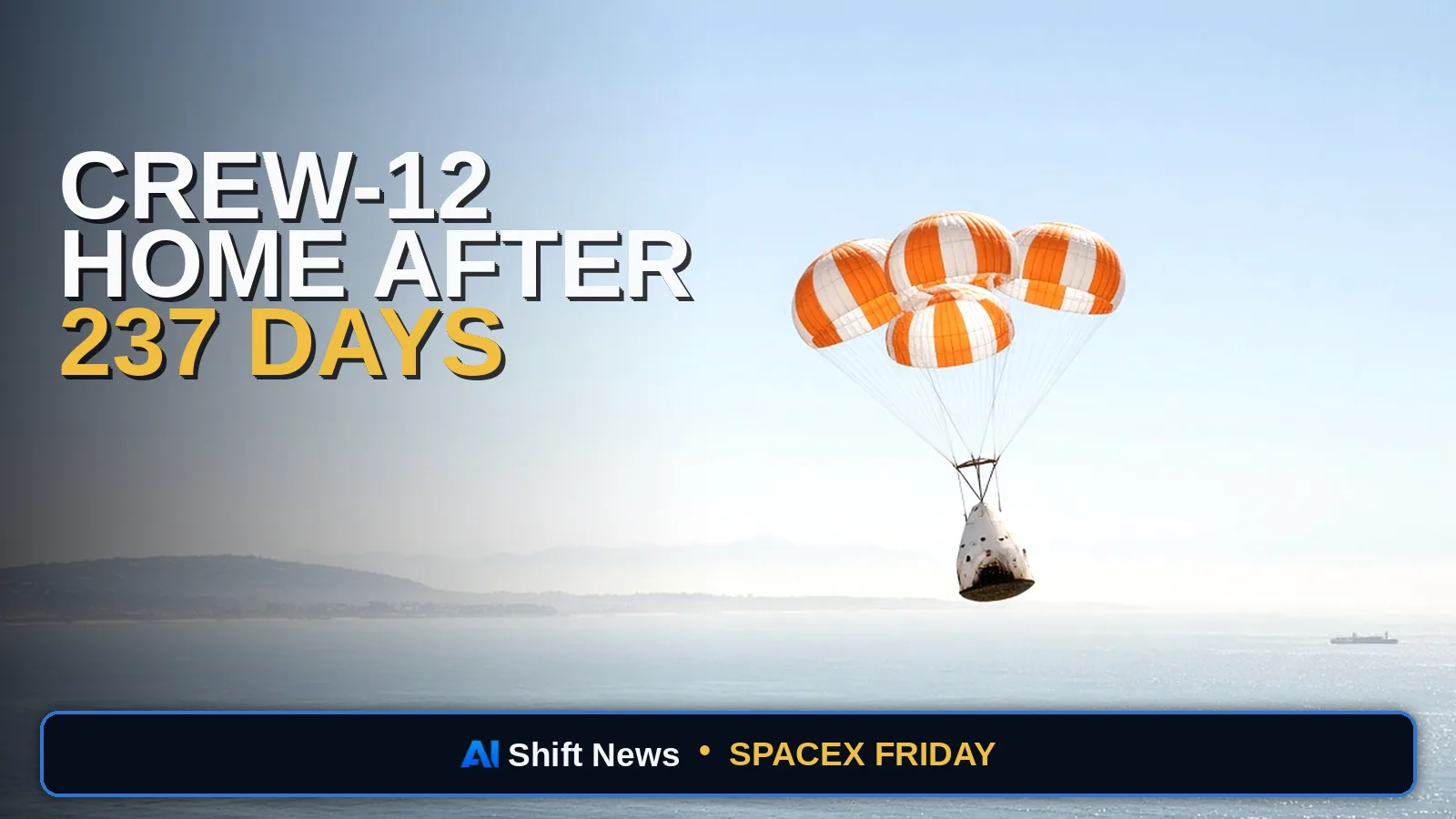
Honest fence (read first): This SpaceX Friday flagship is built on NASA’s own release and blog from October 8 and on SpaceX’s posts on X, with text checked through api.fxtwitter.com. NASA says Dragon Freedom splashed down in the Pacific off Los Angeles at 8:34 a.m. PDT (11:34 a.m. EDT) with NASA’s Jessica Meir and Jack Hathaway, ESA’s Sophie Adenot and Roscosmos cosmonaut Andrey Fedyaev, after a 237-day mission. SpaceX posted “Splashdown of Dragon confirmed!” two minutes later. The next-Dragon facts come from NASA’s CRS-35 pages. What this is: a completed crew return and a dated cargo target. What it is not: a confirmed CRS-35 launch, crew-health data beyond NASA’s standard line, or a sign of any Dragon problem. None was reported. The embed is NASA’s official re-entry and splashdown broadcast (x6p9Ri0DlNE). Its description says “235 days” and “nearly 3,800” orbits, while NASA’s release says 237 days and more than 3,792 orbits. We use the release.
NASA — “NASA’s SpaceX Crew-12 Re-Entry & Splashdown” (published October 8, 2026). NASA’s own broadcast of the return; the splashdown time and mission length cite NASA’s release and station blog below, and the CRS-35 date is a target, not a launch.
Editorial Thesis
Starship gets the headlines, but Dragon is the SpaceX business that is flying people right now. In one week it launched Crew-13 (October 1), brought Crew-12 home (October 8) and lined up a cargo Dragon for October 13. That routine is the story. A capsule that has flown before carried four people through reentry and landed off California on the minute NASA had published. Nobody was surprised, and that is the point.
It also shows how SpaceX’s two crewed-transport eras overlap. Dragon is the working fleet. Starship is the next system, still on planning slides (see today’s other flagship). The Dragon schedule is the one NASA actually builds its station plans around.
Honest Verdict
Believe the return, the time and the crew. NASA, the customer, published all three, and SpaceX confirmed the splashdown. Believe the mission numbers as NASA’s: 237 days, more than 100 million miles, more than 3,792 orbits. Treat CRS-35 on October 13 at 6:33 a.m. EDT as a target. Weather and the ISS schedule move cargo launches all the time. Treat Freedom’s flight history (Crew-4, Ax-2, Ax-3, Crew-9, now Crew-12) as SciNews’ list, not a NASA statement we fetched. And don’t fill in health details. NASA said only that the crew had “standard postflight medical screenings” before flying to shore.
What the primary actually says
NASA (Release 26-083 and Space Station blog, Oct 8)
- Dragon Freedom splashed down “in the Pacific Ocean off the coast of Los Angeles” at 8:34 a.m. PDT. The blog gives 11:34 a.m. EDT.
- Crew: NASA’s Jessica Meir and Jack Hathaway, ESA’s Sophie Adenot and Roscosmos’ Andrey Fedyaev.
- 237 days, “more than 100 million miles,” “more than 3,792 orbits.” Crew-12 launched February 13 at 5:15 a.m. EST and docked a day later.
- Meir did four spacewalks this mission, for seven in her career, third among NASA women behind Peggy Whitson and Suni Williams. The blog adds that she has 440 days in space, putting her in NASA’s top 10. Adenot did three spacewalks, the first French woman to do one from the station.
- Research named by NASA includes stem-cell production, on-demand IV fluid, and pneumonia bacteria and long-term heart damage.
- NASA Administrator Jared Isaacman: “Building the capability, experience, and confidence to do this repeatedly is exactly what will allow us to go farther.”
- Crew news conference: Thursday, October 15, 3:30 p.m. EDT, Johnson Space Center.
SpaceX (on X)
- Oct 7, 8:07 AM ET: “Dragon separation confirmed!” Six minutes later: departure burns under way, splashdown “in ~27.5 hours off the coast of California.”
- Oct 8, 10:25 AM ET: “Dragon will also announce its arrival with a brief sonic boom prior to splashing down in the Pacific Ocean.”
- Oct 8, 11:36 AM ET: “Splashdown of Dragon confirmed!”
NASA’s undocking blog gives a different time (11:05 a.m. EDT), and an older coverage line on that page doesn’t match either. We say only that Dragon undocked on the morning of Wednesday, October 7.
The next Dragon: CRS-35 (NASA, Oct 7)
- Falcon 9 from Space Launch Complex 40, Cape Canaveral, targeting 6:33 a.m. EDT, Tuesday, October 13.
- More than 6,300 pounds of cargo, including “the final set of International Space Station Roll-Out Solar Arrays.”
- Science named by NASA: LambdaVision-1 (artificial retinas built layer by layer), Stellar Spheroids (3D heart tissue), ELF-Unconventional Glass 2 and MINDS brain organoids.
- An empty foam clamshell goes up to bring home the failed Canadarm2 joint replaced on a June 30 spacewalk.
- Autonomous docking around 11 a.m. Thursday, October 15. About a month docked, then splashdown off California in mid-November.
Claim vs proof scoreboard
| Claim | Proof today |
|---|---|
| Crew-12 is home, off Los Angeles, 11:34 a.m. EDT Oct 8 | NASA release + blog; SpaceX “Splashdown of Dragon confirmed!” |
| 237 days, 100M+ miles, 3,792+ orbits | NASA release (NASA’s video description says 235 days, nearly 3,800 orbits) |
| The capsule was Dragon Freedom | NASA release |
| Freedom’s fifth flight | SciNews’ list (Crew-4, Ax-2, Ax-3, Crew-9). Not on a NASA page we fetched |
| CRS-35 launches Oct 13 | Target only, per NASA (6:33 a.m. EDT) |
| The last roll-out solar arrays are on CRS-35 | NASA coverage release |
| The crew is healthy | NASA says “standard postflight medical screenings.” Nothing more published |
What to watch next
- Tuesday, Oct 13, 6:33 a.m. EDT: CRS-35 on Falcon 9 from SLC-40, and the first-stage landing.
- Thursday, Oct 15: CRS-35 docking around 11 a.m., and the Crew-12 news conference at 3:30 p.m.
- The roll-out solar array installation spacewalks that follow, once NASA schedules them.
- Any NASA or SpaceX update on Dragon fleet life and reuse limits (our Aug 14 post covers why it matters).
Human review risks
- Writing “CRS-35 launches Tuesday” as fact. It is a target.
- Using the 235-day figure from NASA’s video description. The release says 237.
- Stating Freedom’s flight count as NASA’s.
- Implying any medical issue or Dragon anomaly. None was reported.
- Giving an exact undock time. NASA and SpaceX disagree, so we say “morning.”
Bottom Line
Believe the return, the time and the crew. NASA, the customer, published all three, and SpaceX confirmed the splashdown. Believe the mission numbers as NASA’s: 237 days, more than 100 million miles, more than 3,792 orbits. Treat CRS-35 on October 13 at 6:33 a.m. EDT as a target. Weather and the ISS schedule move cargo launches all the time. Treat Freedom’s flight history (Crew-4, Ax-2, Ax-3, Crew-9, now Crew-12) as SciNews’ list, not a NASA statement we fetched. And don’t fill in health details. NASA said only that the crew had “standard postflight medical screenings” before flying to shore.
Sources
- NASA Release 26-083 — NASA’s SpaceX Crew-12 Splashes Down, Sets Briefing to Discuss Mission (Oct 8, 2026)
- NASA Space Station blog — Crew-12 Dragon splashes down at 11:34 a.m. EDT (Oct 8, 2026)
- SpaceX on X — 'Splashdown of Dragon confirmed!' (Oct 8, 2026, 11:36 AM ET)
- SpaceX on X — departure burns; splashdown in ~27.5 hours off California (Oct 7, 2026)
- SpaceX on X — Dragon will announce its arrival with a brief sonic boom (Oct 8, 2026)
- NASA — coverage set for SpaceX CRS-35: 6:33 a.m. EDT Oct 13; final ISS Roll-Out Solar Arrays
- NASA — SpaceX 35th Commercial Resupply Mission overview (Oct 7, 2026)
- NASA — NASA's SpaceX Crew-12 Re-Entry & Splashdown (Oct 8, 2026)
- SciNews — SpaceX Crew-12 splashdown (Oct 8, 2026; alt short video, Freedom flight history)
- AI Shift News — Crew Dragon’s real constraint is qualified fleet life (Aug 14, 2026; context)